EduNes Logo

Less Stress ↓

More Success ↑

EduNes means


Educational Network for Excellence and Success

EduNes Students
Showing posts with label strength of Materials. Show all posts

Monday, 4 August 2014

NATURE OF PLASTIC DEFORMATION

NATURE OF PLASTIC DEFORMATION

  • The change of any dimension or shape of an object under the action of external forces is generally considered as a deformation.

  • When external forces are applied on an object, then the deformation along the direction of the applied force is called longitudinal deformation where as any deformation along its transverse directions are called as lateral deformations.

  • When external forces are applied in an object, the object will be deformed first. Due to this deformation crystal structure is also deformed and thus creating an unbalanced internal resisting force, which neutralizes the external force and a condition of equilibrium is achieved as deformation stopped.

  • When the deformation per unit length is small, the material shows a remarkable ability to recover its original shape and size as the external forces are removed.

  • Hence, as the external force is withdrawn, the deformation will be vanished.

  • This type of deformation is called elastic deformation and this property of the material is known as Elasticity.

  • During the elastic phase of deformation, no permanent change in crystal structure happens, but as the magnitude of the applied force increases, resistance due to the change or distortion of the crystal structure becomes insufficient and as a result crystal dislocation occurs.


  • Plastic deformation is the deformation which is permanent and beyond the elastic range of the material. Very often, metals are worked by plastic deformation because of the beneficial effect that is imparted to the mechanical properties by it.

  • The necessary deformation in a metal can be achieved by application of large amount of mechanical force only or by heating the metal and then applying a small force.

  • The deformation of metals which is caused by the displacement of the atoms is achieved by one or both of the processes called slip and twinning. These two are the prominent  mechanisms  of  plastic  deformation,  namely  slip  and  twinning.

  • SLIP AND TWINNING

  • Slip is the prominent mechanism of plastic  deformation in metals. It involves sliding of blocks of crystal over one other along definite  crystallographic planes, called slip planes.

  • It is analogous to a deck of cards when it is pushed from one end. Slip occurs when shear stress  applied exceeds a critical value. 

  • During  slip  each  atom  usually  moves  same  integral  number  of  atomic  distances  along  the  slip  plane  producing a  step  but  the  orientation  of  the  crystal remains the same.

  •  Generally  slip  plane  is  the  plane  of  greatest  atomic  density, and  the  slip  direction  is  the   close  packed  direction  within  the  slip  plane.

  • Twining : Portion  of  crystal  takes  up  an  orientation  that  is  related  to  the  orientation  of  the  rest  of  the  untwined  lattice  in  a  definite, symmetrical  way.

  • The  twinned  portion  of  the  crystal  is  a  mirror  image  of  the  parent  crystal.

  • The plane of symmetry is called twinning plane.

  • The  important role of twinning in plastic deformation is that it causes changes in plane orientation so that further slip can occur.

  • On the macroscopic scale when plastic deformation occurs, the metal appears to flow in the solid state along specific directions which are dependent on the type of processing and the direction of applied force.

  • The crystals or grains of the metal get elongated in the direction of metal flow. This flow of metal can be seen under microscope after polishing and suitable etching of the metal surface. These visible lines are called as “fibre flow lines".

  • Since the grains are elongated in the direction of flow, they would be able to offer more resistance to stresses acting across them. As a result, the mechanically worked metals called wrought products would be able to achieve better mechanical strength in specific orientation, that of the flow direction.

  • Since it is possible to control these flow lines in any specific direction by careful manipulation of the applied fibres. It is possible to achieve optimum mechanical properties.

  • The metal of course, would be weak along the flow lines. The wastage of material in metal working processes is either negligible or very small and the production rate is in general very high. These two factors give rise to the economy in production.

  • HOT WORKING AND COLD WORKING

  • The metal working processes are traditionally divided into hot working and cold working processes.

  • The division is on the basis of the amount of heating applied to the metal before applying the mechanical force. Those processes, working above the recrystallisation temperature, are termed as hot working processes whereas those below are termed as cold working processes.

  • Under the action of heat and the force, when the atoms reach a certain higher energy level, the new crystals start forming which is termed as recrystallisation.

  • Recrystallisation destroys the old grain structure deformed by the mechanical working, and entirely new crystals which are strain free are formed.

  • The grains in fact start nucleating at the points of severest deformation.

  • Recrystallisation temperature as defined by American Society of Metals is "the approximate minimum temperature at which complete recrystallisation of a cold worked metal occurs within a specified time".

  • The recrystallisation temperature is generally between one-third to half the melting point of most of the metals. The recrystallisation temperature also depends on the amount of cold work a material has already received. Higher the cold work, lower would be the recrystallisation temperature as shown in Fig. given below.


  • Though cold work affects the recrystallisation temperature to a great extent, there are other variables which also affect the recrystallisation temperature

  • In hot working, the process may be carried above the recrystallisation temperature with or without actual heating.

  • For example, for lead and tin the recrystallisation temperature is below the room temperature and hence working of these metals at room temperature is always hot working. Similarly for steels, the recrystallisation temperature is of the order of 1000oC, and therefore working below that temperature is still cold working only.
  • In hot working, the temperature at which the working is completed is important since any extra heat left after working will aid in the grain growth, thus giving poor mechanical properties.

  • The effect of temperature of completion of hot working is profound. A simple heating where the grain start growing after the metal crosses the recrystallisation temperature. But, if it is cooled without any hot working, the final grain size would be larger than the grain size in the initial stage of heating.

  • Again, after heating, if the metal is worked before cooling the result is the reduction in size. It is due to the process of recrystallisation, that new grain will be started to form and the final grain size is reduced. This phenomena rises due to working of metal at recrystallisation, that gives rise to a large number of nucleation sites for the new crystals to form.

  • But if the hot working is completed much above the recrystallisation temperature the grain size start increasing and finally may end up with coarse grain size.
  • This increase the size of the grains occurs by a process of coalescence of adjoining grains and is a function of time and temperature.

  • This is not generally desirable. If the hot working is completed just above the recrystallisation temperature, then the resultant grain size would be fine. The same is schematically shown for hot rolling operation.
  • Monday, 21 July 2014

    SAMPLE SHEET: GATE 2015; STRENGTH OF MATERIALS (MECHANICAL ENGINEERING)

    CRACKGATE EDUCATION
    House No: 237; Sector – 5; Chiranjeev Vihar, Ghaziabad
                         Contact No : #9555921800
    PRACTICE WORKSHEET GATE-2015
    MECHANICAL ENGINEERING
    TOPIC: STRENGTH OF MATERIALS
    Difficulty Level: 1
    SET ONE: Each question has several entries, choose the most appropriate one

    01)  The intensity of stress which causes unit strain is called
                a) unit stress                                                     b) bulk modulus
                c) modulus of elasticity                                               d) principal stress
    02)  Which of the following materials has poisson’s ratio more than unity
                a) steel                                                                         b) copper
                c) cast iron                                                       d) none of these
    03) The change in the unit volume of a material under tension with increase in its Poisson’s ratio will
                a) increase                                                       b) decrease
                c) increase initially and then decrease              d) remain same
    04) In a tensile test, near the elastic zone, the tensile strain
                a) increases more quickly                                b) decreases more quickly
                c) increases in proportion to the stress                         d) increases more slowly
    05) The stress necessary to initiate yielding is
                a) considerably greater than that necessary to continue it
                b) considerably lesser than that necessary to continue it
                c) remain same to continue it
                d) can’t be predicted
    06) Flow stress corresponds to
                a) fluids in motion                                           b) breaking point
                c) plastic deformation of solids                                   d) rupture stress
    07) The maximum strain energy that can be stored in a body is known as
                a) impact energy                                              b) resilience
                c) proof resilience                                            d) modulus of resilience
    08) Thermal stress is always
                a) tensile                                                          b) compressive
                c) tensile or compressive                                 d) none of these
    09) The loss of strength in compression due to overloading is known as
                a) hysteresis                                                     b) relaxation
                c) creep                                                            d) Bouschinger effect
    10) If a material expands freely due to heating, it will develop
                a) thermal stress                                               b) lateral stress
                c) creep stress                                                  d) no stress


    Sunday, 9 November 2008

    S.F.D. for CANTILEVER BEAMS

      Edunes Online Education

    B.Tech Mechanical Engg.

    Engineering Mechanics : SFD and BMD
    Cantilever Beam

    How to draw the SFD and BMD of a Cantilever Beam


    Edunes Online Education

    SHEAR FORCE & BENDING MOMENT – CANTILEVER BEAM

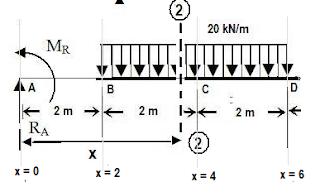
    A Cantilever Beam is fixed at one end and free at the other. At the fixed end, three reactions exist:
    • Vertical Reaction (RA)
    • Horizontal Reaction (HA)
    • Reaction Moment (MR)
    🧠 MEMORY IMAGE: Think of your arm stretched out holding a weight. Your shoulder = Fixed End. Your palm = Free End. The shoulder must resist force AND rotation.

    STEP 1: HOW TO THINK (NOT JUST SOLVE)

    Before writing equations, ask:
    1. Where is the fixed end?
    2. What forces exist on the left of my section?
    3. Is load point, UDL, or UVL?
    4. What is positive?
      (Upward + , Downward −)
    CORE IDEA: Shear Force at section = Algebraic sum of vertical forces on LEFT side.

    Bending Moment at section = Sum of (Force × distance) on LEFT side + applied moments.
    🧠 Golden Rule:
    “CUT – ISOLATE – SUM – WRITE”

    1. Cut the beam
    2. Look LEFT
    3. Sum forces
    4. Write equation
    Cantilever

    Draw shear force & bending moment diagrams and equations

    Cantilever reactions

    Cantilever reactions and Momemts

    SECTION AB (0 ≤ X ≤ 2)

    Cantilever section AB
    For 0 ≤ X ≤ 2

    Shear Force:
    SF = RA = 130 kN

    Bending Moment:

    BM = − MR + RAX
    BM = −720 + 130X
    X Shear Force (kN) Bending Moment (kN·m)
    0 130 −720
    2 130 −460
    🧠 Observation:
    If Shear is CONSTANT → SFD is straight line.
    Moment is LINEAR → BMD is sloping line.

    SECTION BD (2 ≤ X ≤ 6)

    Cantilever section BD
    Here UDL starts. UDL effect = Load × length considered.
    Shear Force:
    SF = 130 − 20(X − 2)

    Bending Moment:

    BM = −720 + 130X − {20(X − 2)²}/2
    X Shear Force (kN) Bending Moment (kN·m)
    2 130 −460
    6 50 −100
    🧠 Observation: UDL makes Shear vary LINEARLY.
    UDL makes Moment PARABOLIC.

    SECTION DE (6 ≤ X ≤ 8)

    Cantilever section DE
    Shear Force:
    SF = 130 − 80 = 50 kN

    Bending Moment:

    BM = −720 + 130X − 80(X − 4)
    X Shear Force (kN) Bending Moment (kN·m)
    6 50 −100
    8 50 0
    🧠 IMPORTANT:
    Moment at FREE END of a cantilever = ZERO (if no applied moment).

    FINAL VISUAL LOGIC

    SFD and BMD
    Think Graphically:

    • Point Load → Jump in SFD
    • UDL → Sloping SFD
    • Shear constant → Straight BMD
    • Shear linear → Parabolic BMD
    • Maximum BM occurs where SF = 0
    🧠 Neurological Anchor:
    Shear = “Force Feeling”
    Moment = “Rotation Feeling”

    If force is constant → moment changes smoothly.
    If force changes → curvature appears.

    Your brain remembers shapes better than numbers.

    EXAM THINKING STRATEGY

    1. Draw FBD first.
    2. Write reactions.
    3. Divide into segments.
    4. Write SF equation.
    5. Integrate logic to get BM.
    6. Verify boundary conditions.
    🧠 Final Compression Formula:

    Cantilever Fixed End → Maximum Moment
    Free End → Zero Moment
    UDL → Parabola
    Point Load → Straight Line

    Visualize before calculating.

    HOME BUTTONS

    © Edunes Online Education | BTech | Mechanical Engineering